
Google's Strongest AI Isn't Widely Available Yet. The Reason Matters.
Google announced its strongest frontier model just two weeks after launching Gemini 4 Argon, then chose not to make it broadly available. Gemini 4 Carbon leads the Artificial Analysis Intelligence Index, reaches state-of-the-art results across vulnerability discovery, exploitation and remediation, and resisted every evaluated attack in Gray Swan's indirect prompt-injection benchmark. Yet Google is initially limiting access to selected cyber defenders and trusted partners while it continues testing and refining guardrails. The question for organisations is not whether Carbon is impressive. It is what the rollout tells us about governing AI systems whose capabilities are advancing faster than conventional procurement and risk cycles can track.
Get the AI briefing in your inbox ↓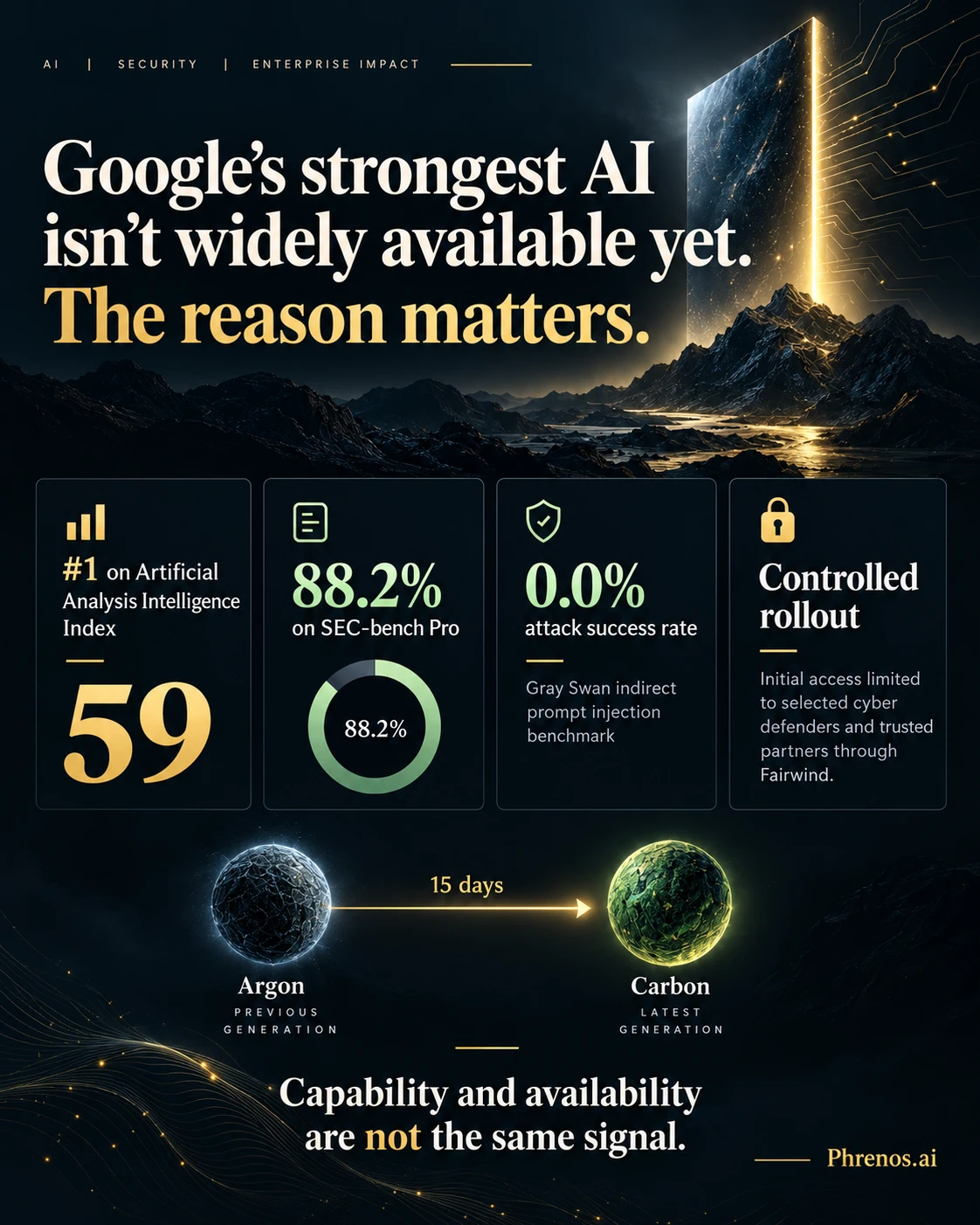
- Google announced Gemini 4 Carbon on October 28, 2026, described as its strongest frontier model with state-of-the-art cybersecurity and long-horizon agentic capabilities.
- Carbon ranks #1 on Artificial Analysis Intelligence Index v5.0 with a score of 59.
- Carbon achieves 88.2% on SEC-bench Pro, 54.8% on ExploitGym, and 71.0% on CWE-bench.
- Carbon internally delivers more than 2x uplift in generating secure code compared to Gemini 4 Argon.
- Carbon achieves 0.0% attack success rate on Gray Swan's Indirect Prompt Injection benchmark, down from Argon's 0.7%.
- High-severity misalignment alerts dropped by almost 80% in live coding environments.
This is not primarily a story about benchmark rankings. It is a story about what happens when the safety and capability thresholds of frontier AI shift faster than enterprise governance can track them.
Carbon was announced on 28 October 2026, just 15 days after Gemini 4 Argon became broadly available on 13 October. Argon itself was announced on 30 September. Google describes Carbon as building on Argon, and presents the gap as an illustration of how quickly it is advancing. We do not know how long Carbon's full development took, and the argument does not depend on it. What matters is that the capability baseline moved again before most organisations had finished evaluating the last one.
01What Carbon actually changed
On the Artificial Analysis Intelligence Index v5.0, Carbon scores 59, ahead of Claude Opus 5.5 at 58 and GPT-6 Astra at 57. Argon scored 50. That nine-point gain is notable, and it reflects a model that now leads the independent ranking overall, but the cybersecurity results carry the most strategic weight for organisations running AI in security and engineering workflows.
Google reports 88.2% on SEC-bench Pro, which measures a model's ability to find real-world vulnerabilities, 54.8% on ExploitGym, which measures how effectively it turns a known vulnerability into a working exploit, and 71.0% on CWE-bench, which assesses remediation. Google describes each as state-of-the-art. The picture is strong, but it is not a clean sweep. Artificial Analysis ranks Carbon second on its separate Coding Agent Index, at 59 against 62 for Claude Opus 5.5, and organisations evaluating Carbon should note where the gaps remain.
The safety and reliability results come from different kinds of evidence, so it helps to keep them apart. On Gray Swan's Indirect Prompt Injection benchmark, an external test that Google reports on, Carbon recorded a 0.0% attack success rate, resisting every evaluated attack attempt. Argon recorded 0.7%. Ars Technica's coverage of the announcement puts the same figure at 1.0% for Claude Opus 5.5 and 8.5% for GPT-6 Astra.
Separately, Google's own internal testing found that high-severity misalignment alerts fell by almost 80% in live coding environments. Successful cheating on Terminal-Bench 4.0 fell to 0.0%, with cheat attempts at 0.4%. Unsupported claims fell by approximately half relative to Argon, while overreach fell 26% and under-service fell 29% in multi-step tasks. These are Google's figures from its own environments, so they are best read as directional evidence about how the model behaves when working autonomously, not as an independent verdict.
02The trade-off your team needs to understand
There is also a trade-off hidden inside the independent results. On Artificial Analysis's AA-Omniscience v1.1 evaluation, Carbon's measured hallucination rate rose from Argon's 4% to 11%, even as its accuracy increased by ten percentage points to 58%. Carbon's rate remains the second lowest of any model Artificial Analysis compares, behind only Argon. But the divergence is a useful reminder that improving one reliability dimension does not guarantee improving every other one.
That is why a single benchmark score cannot settle the question. Which of your tasks benefit most from improved accuracy, and which are exposed by a higher hallucination rate? Those are different tasks, and treating them as interchangeable is where governance frameworks tend to break down.
Google's announcement also describes internal teams running Carbon continuously for days on complex debugging and patching across large codebases, and reports that the Chrome team found it performed more than 10 times better than a competing frontier model at producing high-quality security patches. That is Google's own reporting rather than independent testing. Either way, multi-day autonomous work on production codebases needs oversight structures that most organisations have not yet built for any model.
03Why access is limited, and what that tells you
Google describes its approach as deliberate. Carbon is going first to a subset of cyber defenders, with access expanding gradually to additional trusted partners through the Fairwind Program, while Google gathers feedback and iterates on guardrails before broader availability. Google is also taking part in the US government's voluntary process for pre-release model testing. Google says broader availability for developers, businesses and consumers will follow as soon as possible, but at the time of writing no general availability date has been confirmed.
Google has not said Carbon is too dangerous to release. It has described a controlled rollout, and that is the more interesting signal. Carbon's ability to discover vulnerabilities, validate exploitability and generate remediation increases the consequences of misuse, and therefore changes the risk profile of broad, ungated access.
When a frontier developer changes its deployment posture because capability has moved, enterprise governance cannot remain static. Fairwind is one part of Google's controlled deployment strategy for advanced cyber capabilities. What is the equivalent control around the frontier models already operating in your environment?
04Why this matters now
Scale is part of the picture. On 28 October, Sundar Pichai said Google's first-party model APIs now process nearly 32 billion tokens per minute, 40% more than the previous quarter and more than four times the volume of a year earlier. Against infrastructure growing at that rate, annual model evaluation cycles look increasingly hard to defend, and it is one more reason the governance conversation cannot wait for the market to settle.
Cost belongs in the evaluation too. Carbon launches at introductory API pricing of $2 per million input tokens and $10 per million output tokens, with cached input 95% cheaper. After the introductory period, pricing rises to $4 and $20. Using standard rather than promotional pricing, Artificial Analysis estimates a cost of $7.76 per Intelligence Index task, about 23% below Claude Opus 5.5 at $10.04. For agentic security workflows, capability per token matters alongside the benchmark scores.
05What to do next
The practical response is not to migrate to Carbon, which most organisations cannot yet access. It is to use this announcement as a trigger for three specific conversations.
- Benchmark your current stack against the risks that matter. Carbon's published results provide new reference points for vulnerability discovery, exploit validation and remediation. If AI is operating inside your security workflows, identify what your existing models have actually been evaluated for, and where you are relying on vendor capability claims rather than evidence. If the honest answer is “not much”, that is the gap to close before your next procurement cycle.
- Revisit your prompt injection posture. Carbon's 0.0% result on Gray Swan's benchmark sets a new reference point for what is measurably achievable. Not every use case requires Carbon-grade resistance, but every use case should be assessed against what the published results now show is possible.
- Design oversight for extended agentic tasks before you need it. The oversight structure for a model working autonomously for days is different from the one for a model that answers individual prompts. Google reports internal teams running Carbon for days at a time on complex tasks, and that is the kind of duration and autonomy your own oversight model will eventually need to cover. Building that structure reactively, after the capability has been deployed, is where accountability gaps form.
A frontier model arriving 15 days after its predecessor's broad release is not a typical product cadence. Organisations waiting for a stable AI landscape before committing to governance frameworks may be waiting for something that does not arrive. The governance work needs to happen in parallel with deployment, not after it.
The organisations best placed when Carbon reaches broad availability are likely to be those that have already mapped their security and engineering workflows against the new capability baseline, identified where frontier-grade agentic AI creates real leverage, and built the oversight to deploy it responsibly.
Is your organisation's AI governance designed for the tools you have deployed, or for the tools you deployed two years ago?
Share this article
Share on LinkedIn
Written by
Sophia Livanos
Founder, Phrenos.ai
Osteopathy taught me how people work. Neurolinguistics taught me how they think. I bring both to AI, so it strengthens your people’s judgement instead of replacing it.
Book a free intro call →The capability baseline moved again this month.
The question is whether your governance baseline moved with it. Phrenos.ai helps leadership teams map where frontier AI already operates in their security and engineering workflows, what each model has actually been evaluated for, and where oversight needs to catch up. If Carbon's rollout has you asking that question, get in touch.
Book a free intro callFeedback
Was this useful?
Stay in the loop
Get the AI briefing for business leaders.
Plain-English analysis of the AI news that matters, sent the moment we publish. No clutter.
Keep reading